Posts

Showing posts with the label Reading

Extra Credit Reading Notes: Beowulf, Part B

Image
   Stories source:   The Story of Beowulf by Strafford Riggs Grendel Attacks For the most part, there was a heavy emphasis on the description of the setting, especially the darkness, the trees, the fog, and the wind  This really set up for the introduction of Grendel, which would be the antagonist that Beowulf would have to fight against "The fog parted evenly, and in the wide path is made through the night, a Shadow loomed gigantic in all that was left of moonlight" In terms of the Grendel, the author first characterized it as the "Shadow" Of course, the author already knew what the creature was, but I think the usage of this name was for the readers to see from Beowulf's point of view Also, it could be for a dramatic effect that would set up for the introduction of Grendel Everything that happened within this story was of little to no action, except for the end. However, the author did a great job of vividly describing the setting and expanding on the environm...
Extra Credit Reading Notes: Beowulf, Part A

Image
  Stories reference below were from  The Story of Beowulf by Strafford Riggs King Hygelac of Geatsland  Started off the story with a common introductory sentence, "Once upon a time, ... " Is this too overused? Tacky? Why do so many fairy tales and accompanying myths start off with this introduction? At the beginning of the story, before the characters were introduced, the author illustrated the setting of the story -- the monsters that resided in the oceans, the beasts that were in the forests For many of them, the author included ghastly details -- something to intrigue the reader into continuing with the story There was also a lot of discussion about the cultures of the lands and their surrounding lands as well. About how they were warring constantly At first, I thought this story wasn't as fantastical as it was made out to be. When I came upon the fact that there were monsters was where the story got a lot more interesting for me and my mind was filled with the possibi...

Reading Notes: Dante's Inferno, Part B

Image
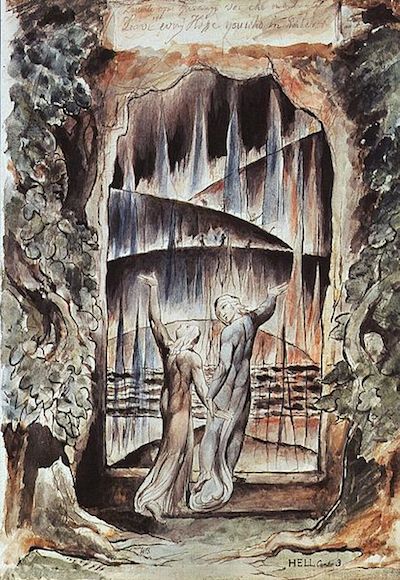
   Stories are derived from   Dante's Divine Comedy, by Tony Kline The Minotaur and the Centaurs With the introduction, it connects to the story of the Minotaur and Theseus, which was the one who slain him and sent him to the Underworld Virgil mentioned his doom and the hero that done the deed to the Minotaur, which made the Minotaur very upset, which was a sign for Dante to descend further into the Underworld There didn't need to be an additional story that was added for the Minotaur, which made a special appearance laying on the top of a gully, but that's all There were a group of centaurs seen after the descent into the 7th circle, each of them armed and racing one after the other like they would on the Earth above When questioned, Virgil said that he would only answer to Chiron, which by further research was the son of the Titan Cronus Why does this make him important? Why do they seek only him? The one that was speaking to him happened to be Nessus, but how does Virg...

Reading Notes: Dante's Inferno, Part A

Image
   Stories below are derived from   Dante's Divine Comedy, by Tony Kline Dante and Virgil Very good introduction, the author is either talking to himself or directly to the reader. He tells of how lost and scared he was when entering the "impenetrable" woods, creating a personal note to the reader about how fearful he was Doesn't say too much, but definitely instilled a mood for the reader to start with the rest of the story Included a character called Divine Love Will this character be introduced later? Or was this just a general idea that the readers should know about? A manifestation of a feeling or emotion as a tangible character? When Dante met Virgil, Virgil introduced himself in a very odd way. He included many names of his lineage as well as who was associated with him in the past It also seemed that Dante knew who Virgil was, and also regarded him as his "master" VIRGIL IS HIS GUIDE THROUGH HELL?? At this point, it makes a lot more sense about who D...

Reading Notes: Russian Folktales, Part B

Image
Stories derived from  Russian Fairy Tales by W. R. S. Ralston The Headless Princess The king has a daughter who was an "enchantress" Usually, I've never read of royalty having any powers at all. Does the King also have powers? If not, why only the princess? The story is odd in terms of the message that it was trying to convey. For the most part, I couldn't figure out if the enchantress was supposed to be the protagonist or the antagonist because it was the priest's son that was peeping. I like how for ritualistic reasons, there are various details .. such as the number of days and the things the characters had to do to prevent from being taken away How did the old woman already know that the Princess was a witch from the start? (The Headless Princess. Source:  RTOO )

Reading Notes: Russian Folktales, Part A

Image
  Stories derived from  Russian Fairy Tales by W. R. S. Ralston  Russia: The Dead Mother There is mentioned a certain village but did not specifically mention the name of the village  This can add to the anonymous atmosphere of the story, which creates a good introduction to the rest of the story Mentioned terminology that was specific to the region of the origin of the story In this case, it was the "moujik" which directly refers to a Russian serf -- basically an unfree peasant of Russia This could categorize as a horror story, something that could invoke terror in the readers Mentions the dead mother next to the cradle of the baby, which was something that the reader did not expect because the story started with the dead mother dying after childbirth! Maybe there's an all-encompassing theme to the rest of the story about the relationship between the baby and the mother, which in this case, can expand passed the limited time on Earth (Mother and Her Child. Source:...

Reading Notes: Celtic Fairy Tales

Image
Stories are derived from  Celtic Fairy Tales by Joseph Jacobs  Connla and the Fairy Maiden Dialogue form stories between characters are very old-fashioned, parallel with the location/origin of the story For example: "Whence comest thou, maiden" Dialogue is also written in poetic form. This can be used for dramatic effect for the introduction of the character as well as the backstory Inclusion of magic in the story, but power is not directly shown but described Druids Member of high-ranking class in Celtic cultures, sometimes as religious leaders, or also legal authorities Priests, teachers, judges (The Fairy Maiden. Source:  J. Batten )

Reading Notes: Robin Hood, Part B

Image
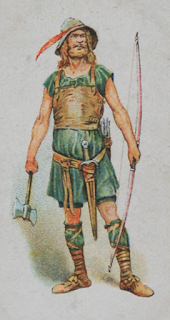
Robin Hood is in disguise once again, this time as a shepherd. Barnsdale is a real place in South Yorkshire, England, and its association with the Robin Hood legend is one of its claims to fame. To disguise himself as a beggar, Little John needs "palmer's weed." The word " palmer " refers to a pilgrim who had visited the holy places of the Middle East and brought back a palm leaf as a token of the pilgrimage. Meanwhile, the word "weed" here refers to clothing, as in the phrase "widow's weeds." The word comes from the Old English waed, meaning "garment." You will also see the word "carel" (carril, carl) in this ballad, which means a low-born person. Bibliography:  The English and Scottish Popular Ballads  by Francis James Child (1882-1898). ( Little John )

Reading Notes: Robin Hood, Part A

Image
Story source: The English and Scottish Popular Ballads by Francis James Child (1882-1898). Robin meets the mother of three poachers, and in order to rescue them, Robin once again disguises himself, this time as a beggar, paying a beggar an extravagant amount of money (forty shillings) to take his place. There are many different versions of this story; in some the boys are brothers (as here), while in other stories they are members of Robin Hood's own band of Merry Men.  ( Statue )

Reading Notes: Aesop's Fables: Dogs, Part B

Image
 These works were shorter of that to the Fox stories I previously read. The stanzas are shorter, but they still rhyme like the Fox section. I chose dogs as opposed to the other animal choices because I am a sucker for dogs. The stories reminded me of the saying "a dog is a man's best friend". These stories reminded me of specific people that I've met or characters in TV.  ( illustration from Baby's Book of Fables ) Bibliography:  The Fables of Phaedrus , translated by Christopher Smart (1887).

Reading Notes: Aesop's Fables: Foxes, Part A

Image
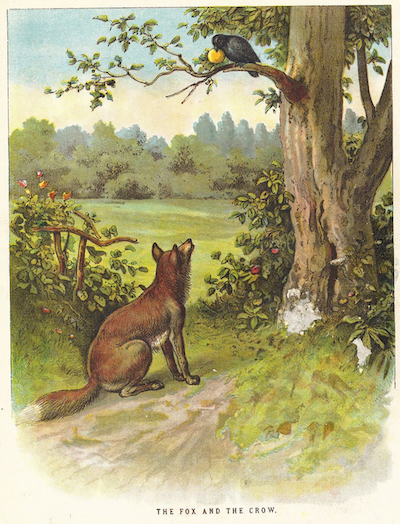
 I like how all of these stories rhyme as they are formatted in a poem. It's very creative and I don't think I could personally do it. In the first story the fox which in normal stories is the trickster is outwitted by another animal. This was a nice twist on a traditional story than what I have read for this class previously. The last story, however, brings it back home where the fox is a trickster to a goat. Goats are traditionally viewed as a very intelligent animal so this was a bit surprising, but still within character.  I noticed with some rhyming patterns that they were the same from each stanza which is impressive.  ( illustration from Baby's Book of Fables ) Bibliography:  The Fables of Phaedrus , translated by Christopher Smart (1887).

Reading Notes: The Rabbit Goes Duck Hunting, Part A

Image
The rabbit used to boast about things that he could do. One day he lied about being a carnivore to an otter. He got trapped in a hole because he messed up during his attempt to trap an animal. He was starving for a couple days, until a family heard him. He called over to them to observe and admire him. They made the whole bigger and he jumped away.  (A Rabbit by  Pixabay ) Bibliography: "The Rabbit Goes Duck Hunting"  Myths of the Cherokee by James Mooney (1900).

Reading Notes: The Little Hunting Dog, Part B

Image
This story had a scholar who didn't like to live with anyone. He witnessed a tiny little kingdom which in my head represented buggs because they were only a couple of inches if that tall. When they all disappeared, they left a little hunting dog. I think the scholar had become fond of the dog, but the dog died. I was so sad when the dog died. I love dogs. However, the dog died protecting the scholar while he slept which makes me even sadder.  ( Rover ) Bibliography: The Chinese Fairy Book , ed. by R. Wilhelm and translated by Frederick H. Martens (1921).

Week 9 Reading Notes: The Panther, Part A

Image
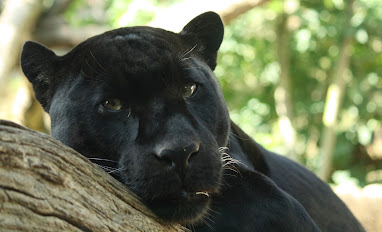
Unlike many stories in this class, this story started with the death of the mom and brother. The two sisters had to fend off against their family's murderer, the panther. When they let the panther come in, they knew it wasn't their mother. They played along with it though so they could trick him. After they hoaxed him to leave, they cried on their porch until venders started hempling them.  "In the evening the panther came home. He sat down in the armchair in the room. Then the needles in the cushion stuck into him. So he ran into the kitchen to light the fire and see what had jabbed him so, and then it was that the scorpion hooked his sting into his hand. And when at last the fire was burning, the egg burst and spurted into one of his eyes, which was blinded. So he ran out into the yard and dipped his hand into the water-barrel, in order to cool it, and then the turtle bit it off. And when in his pain he ran out through the door into the street, the wooden clubs fell on h...

Reading Notes:The Miraculous Mirror, Part B

Image
 This was an interesting story. Throughout the entire reading, there was a lot of adjectives and a lot of imagery to depict the mood and feelings around the characters. For instance: "Sudden from out of the void, by the wrath of the hurricane driven,Into the Hall of the Gods, with the crash of a thunderbolt dire, Down from the summit of Heaven, through a rent in the firmament riven, Hurtled the Dragon of Hell, Susa-no-wo, demon of Fire!"  This is a prime example of word choice in this particular section of the class. Words like Wrath and dire convey emotions around them.  Bibliography:  E. W. Champney and F. Champney, "The Miraculous Mirror", Link

Reading Notes: A Fox and His Wife, Part B

Image
This story should be really be named "The Fox and Her Husband". The wife did all the heavy lifting in getting away from the tiger. She knew she had to be respectful to con the tiger. I mean they even got an escort to their house because the tiger thought he had tricked them, but no one can trick a fox. The tiger got so mad that "Then he saw how he had been fooled and flew into a terrible rage and tried to squeeze his way into the hole, but it was much too small and at last he had to go away baffled, and so the foxes were saved by Mrs. Fox’s wit.". That was all due to Mrs. Fox and the husband did nothing.  ( Red Fox ) Bibliography: A Fox and His Wife, by Cecil Henry Bompas (1909), link: http://www.gutenberg.org/files/11938/11938-h/11938-h.htm#t116

Reading Notes: The Money and the Girl, Part A

Image
Particularly this part of the story shocked me,  "At this, everyone looked up at the sky; then she took some sand which she had in the fold of her cloth and threw it into the air, and it fell into their eyes and blinded them. While they were rubbing the sand out of their eyes, the girl leapt on to the pyre and was burned along with the monkey and died a sati. Her father and brothers were very angry at this and said that the girl must have had a monkey’s soul, and so she was fascinated by him — and so saying, they bathed and went home." This story was anything but dull. To be honest I don't know the point of this story because what was the point of the girl killing herself. It kind of reminded me of Romeo and Juliet though. There aree two star-crossed lovers that can't be together because they are from different worlds.  ( Hanuman Langur Monkey ) Bibliography: The Monkey and the Girl by Cecil Henry Bompas (1909), link:http://mythfolklore.blogspot.com/2014/06/myth-folkl...

Reading Notes: Twenty-Two Goblins, Part B

Image
 So I don't know how I didn't notice this before, but the stories all start with a goblin telling the King a story. I kinda feel dumb because I'm assuming that's why it's called Twenty-Two Goblins. There is a different goblin with a new story every time.  The daughter in the story linked down below was in love with the thief. I guess you can say the thief stole her heart. haha anyways. Everyone wanted the daughter. There were a lot of suitors asking for her hand in marriage, but she saw something in the thief which is kinda sweet.The thief stole a lot from the King and the King couldn't let him go unpunished.  Once the thief was executed and brought back to life because the daughter was so good, he was promoted to general and the thief was reformed. Maybe people can change, but who knows.  Illustration by Perham W. Nahl (1917) Bibliography:  Arthur W. Ryder, The Girl and the Thief,  http://mythfolklore.blogspot.com/2014/06/goblins-girl-and-thief.html

Reading Notes: Twenty-Two Goblins, Part A

Image
 The ending is what really caught my attention when choosing a story to do notes on. At first I was confused at:" When the goblin heard this, he escaped by magic from the king's shoulder and disappeared. And the king followed him as before. Discouragement never enters the brave heart of a resolute man." and the context of this paragraph in the story. The King was sure in his decision of who his daughter should marry in that moment. I always struggled with doubting my decisions and if I truly made the right choice.  I thought it was intersting how the King gave his daughter to the Swordsman. He mentioned he had manhood with his science and it's almost crazy to think of how marriages are set up in some cultures.  Bibliography: Arthur W Ryder, The Four Scientific Suitors,  http://mythfolklore.blogspot.com/2014/06/goblins-four-scientific-suitors.html (illustrations by Perham W. Nahl (1917)

Reading Notes, Adam and Eve, Part B

Image
After Adam and Eve ate the forbidden fruit, God sent them to a cave that was dark. In the cave, Adam was frightened by a snake. Adam begs God to punish them in a place where there are no snakes.God grants this, but with Adam still fearful and insecure he throws himself down the mountain. Eve committed suicide because she was so sad. Adam felt sad that he messed up in the Garden. He never felt hardship with God there looking over him.  (The Garden from Pixabay ) Bibliography:  Rutherford H. Platt, Jr., Suicide and Salvation, http://mythfolklore.blogspot.com/2014/05/adam-and-eve-suicide-and-salvation.html